

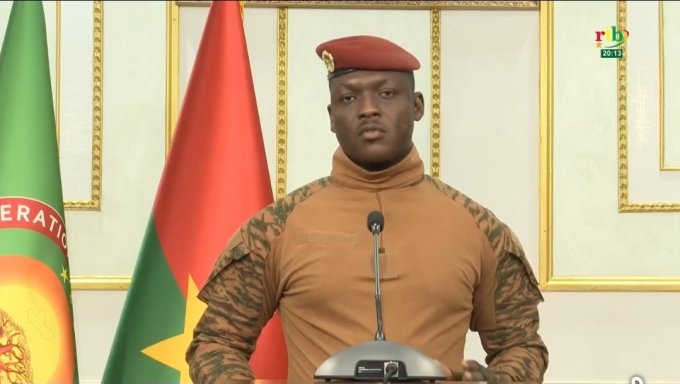
In his address to the Nation on Wednesday, December 31, 2025, the President of Burkina Faso, Captain Ibrahim Traoré, gave a broad overview of government action in 2025 and presented the main guidelines for 2026. Health, education, infrastructure, agriculture, mining, energy, economy, justice, culture, digitalization and diplomacy: the Head of State reviewed the key sectors of national life, emphasizing sovereignty, national production and a return to endogenous values.
The head of state indicated that the technical facilities of existing health centers have been strengthened, particularly in the areas of laboratories and medical imaging. This improvement, coupled with lower service costs, has led to a significant increase in the number of patients, including those from neighboring countries. In 2026, new health centers will be launched, similar to the one at the Pala University Hospital .
In the field of education, the President announced a gradual shift in the system towards technical and vocational training to better meet the country’s development needs. Several technical high schools and university centers will be established, while lecture halls and teaching buildings are nearing completion. The digitalization of education will continue with the deployment of university servers and digital libraries.
Four regions were equipped with road construction brigades in 2025. Four more will be in 2026, enabling the launch of national, departmental, and highway projects. Captain Ibrahim Traoré also announced a shift in the urbanization model, with a focus on high-rise construction to better manage space, improve sanitation, and enhance urban hygiene.
In the mining sector, the State has initiated a process of regaining control of resources through mine acquisitions and the creation of public operating entities. Uncontrolled gold outflows have been reduced thanks to new control mechanisms. Regarding energy and water, a major initiative will be launched in 2026 to improve access to drinking water and electricity, reduce imports, and strengthen energy independence.
The President stated that Burkina Faso achieved food self-sufficiency by 2025, thanks to a successful agricultural season and government support efforts (subsidies, improved seeds, mechanization).

“2025 was a banner year for agriculture and livestock farming. We exceeded our targets for several sectors. Food self-sufficiency was a daily struggle for us. We can now say that we achieved food self-sufficiency in 2025,” he rejoiced. In 2026, the development of reclaimed land will continue, as will the expansion of water reservoirs, fish farming, forage crops, and animal feed production.
The Head of State highlighted the strong performance of the national economy, illustrated by the success of fundraising efforts in the regional market. The widespread adoption of certified electronic invoicing starting in January 2026 will strengthen the fight against fraud and increase state revenue.
The year 2025 was marked by the emergence of new industrial units, particularly in raw material processing. In 2026, several units will begin production, especially in cotton, with the aim of reducing raw exports and increasing national added value.
The President announced the continuation of justice reform, incorporating traditional conflict resolution mechanisms and promoting the social reintegration of prisoners. The digitalization of the administration and the justice system will continue, with the upcoming creation of “citizen centers” in the provinces to facilitate access to public services.
“By 2026, we will ensure that all prisoners have the opportunity for reintegration. Instead of remaining inactive in prison, they will be able to learn a trade, reintegrate into society, and participate in building the nation. This new approach to justice ensures that no one is left behind. Whether free or incarcerated, everyone will be able to contribute to national development. Digitalization is essential, as no fight against corruption is possible without it,” he stated.
Ibrahim Traoré emphasized the need to return to indigenous values: integrity, dignity, and patriotism as the foundation of development. According to him, culture must play a central role in shaping the new Burkinabè.
“Many cultural events took place in 2025, and others will take place in 2026. All these projects must be centered on our ancestral values in order to forge a new Burkinabè, free from corruption and placing the nation above all else,” he declared.
On the diplomatic front, Burkina Faso intends to pursue an open yet sovereign policy, based on mutual respect and the defense of national dignity.
“Burkina Faso has lit a light, and that light must remain lit forever. We are a beacon of influence throughout the world, and our diplomacy is very active. Changes will certainly take place to reorganize the diplomatic apparatus worldwide because geopolitics demands it, and this reorganization already began in 2025 with a number of adjustments in the treatment of diplomats. However, the spatial reorganization across the globe will take place in 2026. We will redirect our diplomacy according to the geopolitical situation emanating from our country. Burkina Faso is a country open to all sincere partners who respect our sovereignty, our freedom, and our dignity, but Burkina Faso will not allow anyone, any power, to impose its will upon us. That is why we must continue, wherever we are, to ensure that the flag of Burkina Faso flies with dignity,” he emphasized.
He concluded by commending the diaspora for its efforts in support of Burkina Faso’s development.


